

The short version
It's 9pm, the kids are down, and someone's on the couch with their phone, getting two or three quotes for a new patio. They're not ringing anyone at this hour. They want to put the job in writing, send it, and know it hasn't gone into a hole.
So we looked through the quote path on 50 trade websites in Brisbane and on the Gold Coast: roof restorers, air conditioning installers, pool builders, kitchen renovators and patio builders, the first five eligible businesses Google Maps showed for each trade in each city. Each site was opened in a phone-sized browser, and nothing was typed or sent.
Most of the forms are fine. 33 of 50 had a short ask: a written way to ask for a price within two taps of the home page, five or fewer fields required as marked, and nothing heavy like a street address or a budget before anyone had talked.
What's missing is one sentence. 6 of 50 said when you'd hear back. Only 4 of 50 did both, a short ask and a stated reply time, which is what we'd set as an easy way in before we opened a single site. 15 of 50 main forms ask for something too early, and none of the 50 offered a smaller way in, like a text link or a three-field call-back.
If you change three things this week, make it these. Put a reply time you can keep next to your quote button and under your form, like "We'll get back to you within one business day". Take the street address off the first form unless you can't route a job without it. And give people a smaller way in for when they're not ready for the full form. Each check is below with the fix for it, and the whole list is at the end so you can run it on your own site tonight.
Home page and quote path read in a phone-sized browser on 26 October 2026, without typing into or sending anything. Fields are counted as required where the page marks them. 3 sites couldn't be scored on the short ask or the easy way in, and 2 on the too-early check, because a form or quote calculator couldn't be fully read.
What counted as an easy way in
We wrote the bar down before we opened a single site, and it's meant to be one an owner can clear in an afternoon. A written way to ask for a price, a form or something smaller, that passes four checks.
It's close: two taps or fewer from the first screen of the home page, with scrolling free. It's short: five or fewer fields required as marked, across every step we could read. Nothing comes too early: no required budget, full street address, "how did you hear about us", photo upload or login. And it says when: a reply time in hours, days or a named day, like "within 24 hours" or "next business day", on the page or in the form.
A phone number alone never counted, however big. Plenty of people will ring, and that's good. The person on the couch at 9pm won't, and they're the one this is about. "We'll be in touch shortly" didn't count as a reply time either, and neither did "fast quotes" or opening hours. A short form without the reply time is what we've called a short ask.
The form is usually short enough
What a customer is looking for: a request they can finish before they lose interest. Their name, a way to reach them, and a line about the job.
What we found: 33 of 50 cleared the first three checks. Every one of the 50 had a written way to ask somewhere on the site. On the 48 main forms we could read in full, the middle count was four or five fields required as marked, and 11 of the 48 asked for more than five.
So the form isn't the problem it's made out to be. Most of these businesses have already done the hard part.
What to fix: keep the first ask to contact details and a short description of the job. Five required fields or fewer. If you need more detail to price it, ask in the first reply, when you're already talking.
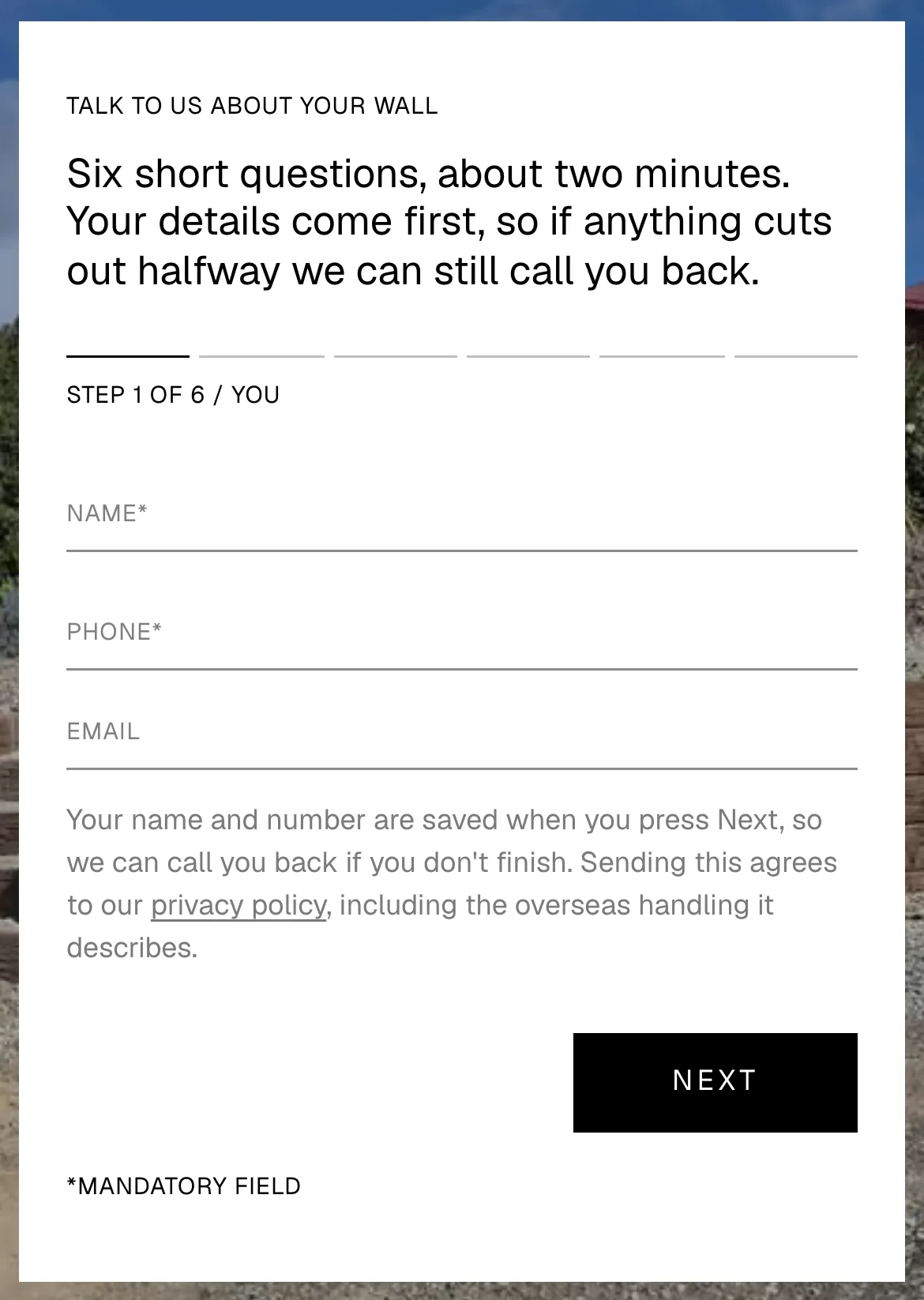
The missing sentence is when
What a customer is looking for: some reason to believe the enquiry won't vanish. When you're getting three quotes, the business that says when it'll come back to you is the one you stop worrying about.
What we found: 6 of 50 said when you'd hear back. That's the gap between 33 short asks and 4 easy ways in. Of the 6, 4 also cleared the other three checks. One asked for a full street address up front, and one form couldn't be read at all.
The ones that counted read like this: "within one business day", "within 24 hours", and on one patio builder's site, the quote itself back within 48 hours. Plenty of others said something like "we'll be in touch shortly" or "fast response". It sounds like a promise, and it doesn't tell the customer anything.
What to fix: write one sentence with a time in it, and put it next to the quote button and under the form. Pick a time you can keep in your busiest week, not your quietest. "Within one business day" you can keep is worth more than "within the hour" you can't. If you can, send the same line back automatically when the form comes in, so it's in their inbox too.
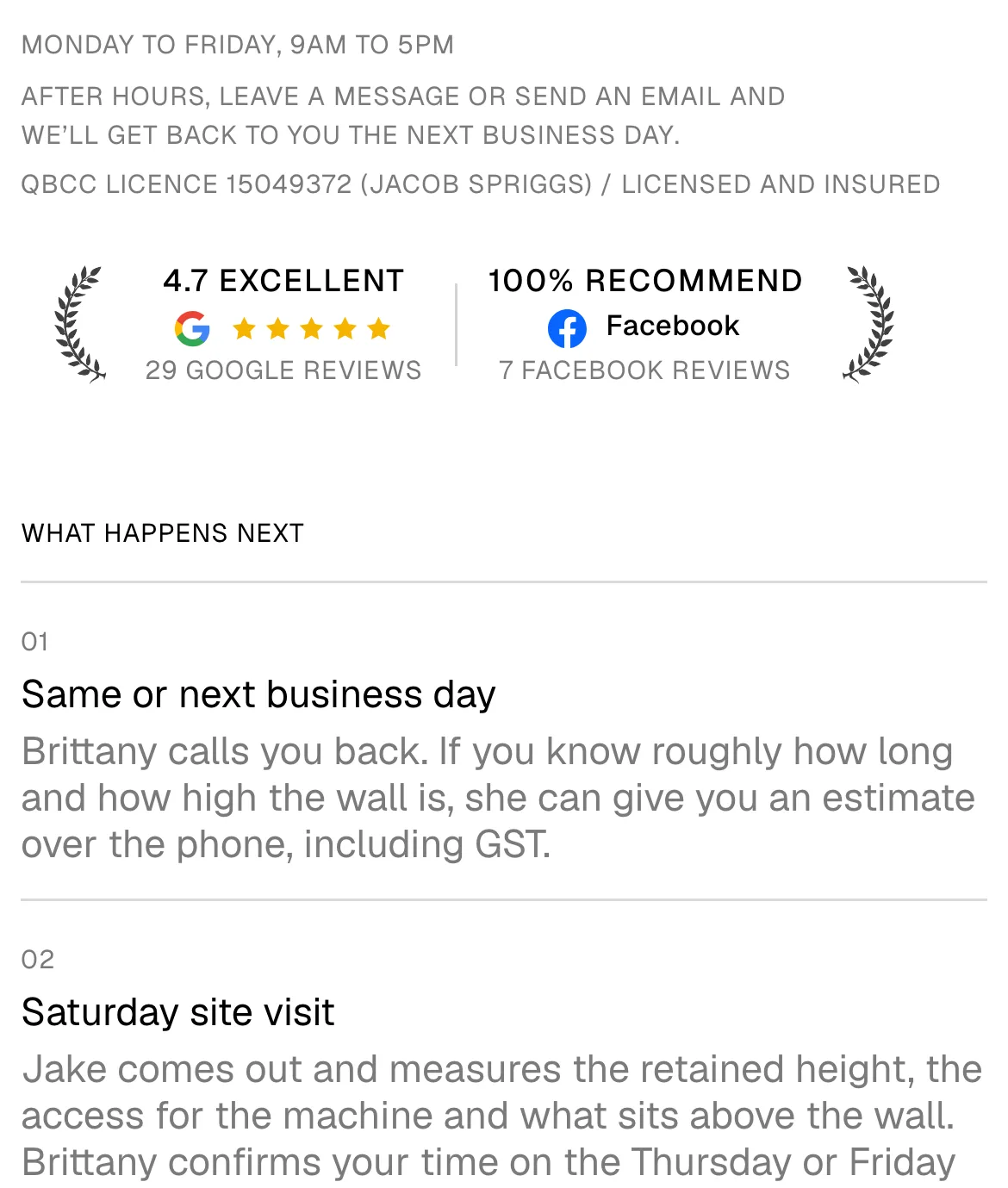
Some questions arrive before trust does
What a customer is looking for: a way to start a conversation without handing over everything first. They don't know you yet.
What we found: 15 of 50 main forms required, as marked, a full street address, a budget, a "how did you hear about us" or another item from the too-early list before anyone had talked. Most of them were a full street address. Suburb or postcode alone didn't count against a site, and an optional field never did. We couldn't tell on 2 forms.
Some trades have a fair reason to ask where the job is. A suburb answers most of that, and the street can wait until you're booking the visit.
What to fix: swap a required street address for a suburb or postcode. Make budget, photos and "how did you hear about us" optional, or ask them in your first reply. If one of them really decides who takes the job, keep that one and drop the rest.
There's no smaller way in
What a customer is looking for: something lighter for when they're not ready for the full quote form. A way to say "I've got a job, here's my number" and leave it there.
What we found: 0 of 50 offered one. We were looking for a text link, a call-back request of three fields or fewer, a "send us a photo for a price guide" path of its own, or online booking that shows a time before you type anything. A chat bubble or an email link didn't count.
We've done the same with our own first ask, cut down to "send us your website". It doesn't need more than that to start.
What to fix: add one separate, smaller option with three fields at most, a name, a number and a line about the job, and label it as the quick version. Put the same reply time under it.
Calls are well covered, and writing is the gap
What a customer is looking for: the choice. Ring now if they can, or leave it in writing if it's late, they're at work, or they'd rather not talk yet.
What we found: the call side is well looked after. 46 of 50 had a quote, contact or call action on the first screen, and 44 of 50 had tap-to-call on the home page. Next to that, 6 of 50 said when a written enquiry would get a reply.
What to fix: keep the call button. Then give the written route the same weight beside it, and the same confidence. A call button says "talk to us now". The reply line says "or leave it with us, and here's when we'll come back to you".
How the 50 were picked, and what got read
The rules were written down before we opened a single website. 10 Google Maps searches, typed exactly as written: roof restoration, air conditioning installation, pool builders, kitchen renovations and patio builders, each for Brisbane and for the Gold Coast, in a browser set to the Brisbane CBD or Southport and not signed in to Google. For each search we took the first 5 businesses in Maps order that passed a skip rule, and logged every skip with its reason.
63 results were walked to get to the 50. The 13 skipped were 8 sponsored results, 2 franchises, 2 listings with no website and 1 site that didn't load. Every search gave 5 eligible businesses within its first 20 results. Current Echo clients and businesses from earlier samples would have been skipped too, and none came up.
Each site was read in a phone-sized browser, 390 pixels wide, starting on the home page and following the quote path through links and menus. Nothing was typed into a form, no Next or Submit button was pressed, and no chat, call or message was started. Forms were read from what the page showed and the form definitions it loaded. Every check was a yes or no against a rule written in advance, and every yes is backed by a saved quote, link or screenshot. The pages were captured on 26 October 2026.
The first business from each search was coded twice, the second time blind, and no check disagreed often enough to need recoding. A second pass then went back through the saved source of all 50 sites for reply-time wording and required markers. That found six forms whose required flags were set inside the form builder rather than on the page, and one reply line that only appears as you scroll. Codes changed on 8 businesses, and the easy-way-in count stayed at 4.
21 of the 50 had an ad we could match to them, either running on Meta that morning or shown on Google in the 30 days before. 3 of the 4 easy ways in were among them. That's too few to say anything about ads, so we're leaving it there.
What this can't tell you
50 is enough to describe these websites and not enough to compare trades or cities. Each trade in each city is 5 sites, so nothing here is split that way. Maps doesn't say how it orders results, and the order shifts with location and time. This is who a homeowner in the city centre saw first on one Monday morning, not a census of trade websites.
Fields are counted as required where the page marks them. A form can insist on more once someone starts typing, and steps that only appear after pressing Next weren't seen. 48 of the 50 main forms could be read in full, 1 in part and 1 not at all, so a handful of sites couldn't be scored on every check.
One close call sits under the 4, and the next section covers another. One form asked for a "Location" as well as a suburb and a postcode, and we read that as a street address. Read the other way, it'd be 5 of 50. The 6 of 50 on reply times doesn't change on that call.
This looks at what the websites show, not what happens after someone sends the form. A business with no reply time on its site might answer every enquiry in ten minutes. The customer reading the page doesn't know that, which is the point.
How much weight to put on this
Treat this as an honest, informal read. It isn't peer-reviewed research and nobody outside Echo has checked it. We've tried to show the working the way a journal paper would, so you can decide for yourself how far to trust it. We don't publish the business names or the raw sheet, so you can't re-mark it yourself. It's 50 websites, picked by a written rule from 10 Google Maps searches, and it's one Monday morning, 26 October 2026. They aren't a random sample. They're the first that qualified in two South East Queensland cities, in five trades, so we wouldn't stretch these numbers to every Australian trade.
You should also know how the judging worked. All of it was done inside Echo, to rules written before the first search, with more rulings on edge cases added during coding and in the review. One of those rulings added a reply line to the 6. A first pass coded the sites, a second went back through the saved source of every site, and a separate check recomputed every figure from the data and checked the wording. The second pass and that check used the same tool, so they aren't fully independent of each other.
A few of the calls are judgement, too. The headline figures are 6 of 50 for reply times and 4 of 50 for an easy way in. One of the 6 promises the quote itself back within 48 hours, not a reply, and we counted it. Leave it out and those figures are 5 and 3. Add the "Location" call above and the easy way in runs from 3 to 5.
It can't show which sites actually win work. A site with a reply time might get no more enquiries than one without, and nothing here can settle that. We also didn't send a single form, so we can't tell you who replies quickly and who doesn't. The fixes we've suggested are our view of what should help, not something this data proves.
And we've got a stake in the answer. Echo sells websites and marketing to businesses like these, and there are invitations to talk to us in this piece. A finding that trade websites could do better suits us, so weigh it with that in mind. We also wrote the rules for what counts as an easy way in, and they reflect how we think a form should work. Someone else could set different bars and get a different number. The examples pictured are our own client's, chosen by us and not drawn from the sample.
It's also a look from the outside at one moment. We can't see how these businesses answer the phone or how busy they are. Some of them might have all the work they want, and a form that asks for more might suit them fine.
The check you can run tonight
Open your own website on your phone, from your Google Maps listing if you can. Pretend it's 9pm and you want a price without ringing anyone. Then go down this list.
- Count the taps
From the first screen of your home page, how many taps until you're looking at a form you could send? Two or fewer is the bar.
- Count the stars
How many fields are marked required? Five or fewer is the bar. 11 of 48 readable forms asked for more.
- Read what the form asks before you've talked
A full street address, a budget, a photo, "how did you hear about us"? 15 of 50 required at least one.
- Read what the form promises
Does it say when you'll hear back, with a time in it? "Shortly" doesn't count. 6 of 50 did.
- Look for a smaller way in
A text link or a three-field call-back for someone who isn't ready for the full form. 0 of 50 had one.
- Send yourself an enquiry
Use your own name and number, then time how long until a reply reaches you. If it beats the time you'd write on the page, write that time on the page.
One more thing
None of this needs a new website. Most of the 50 already have a short form. What they're missing is the sentence that tells a stranger what happens after they press Send, and a business can write that tonight.
The reason it matters is the one in the job you didn't get asked to quote. Someone collecting quotes doesn't ring to tell you they went with the business that said when it'd call back. And if the reply time is the hard part to keep, an automatic reply that repeats it is the first of the five automations every business needs.
What should a quote form on a trade website ask for?
Enough to start the conversation: a name, a phone number or email, a suburb or postcode, and a line about the job. Keep it to five required fields or fewer, and leave the street address, budget and photos for the first reply unless you can't route the job without them. On 50 Brisbane and Gold Coast trade websites we looked through, 33 kept the ask that short.
Should my website say how quickly I'll reply to an enquiry?
Yes, with a time in it, like "within one business day". Put it next to the quote button and under the form, and pick a time you can keep in your busiest week. Of 50 trade websites we looked through in Brisbane and on the Gold Coast, 6 said when a customer would hear back. "We'll be in touch shortly" doesn't tell them anything.
Is it a problem to ask for a street address on a quote form?
It's a lot to ask of someone who hasn't spoken to you yet. A suburb or postcode tells you whether the job's in your area, and the street can wait until you're booking a visit. On the 50 trade websites we looked through, 15 main forms required, as marked, a full street address, a budget or another item like it before anyone had talked, and most of them were the street address.
Isn't a phone number enough for customers who want a quote?
For the ones who can ring, yes, and 44 of the 50 sites we looked through had tap-to-call on the home page. Plenty of people collect quotes at night or at work, when they won't ring. They need a written way to ask and a line saying when you'll come back to them. 6 of 50 gave them that line.
How were the 50 websites chosen?
From 10 Google Maps searches on 26 October 2026: roof restoration, air conditioning installation, pool builders, kitchen renovations and patio builders, in Brisbane and on the Gold Coast, taking the first 5 per search in Maps order that passed a skip rule written beforehand. Sponsored results, franchises, listings with no website and a site that didn't load were skipped and logged. No business is named here; each is described by trade and city at most.
